


Recently I got around to watching The Satanic Rites of Dracula. Which is also known as Count Dracula and his Vampire Bride, along with many other titles. Whatever you want to call it, this was the last in the series of Hammer Dracula movies starring Christopher Lee. This movie offered a nice conclusion to the series, as well as a few new vampire rules. Such as running water instead of holy water. Evidently, in this story just having water running from a tap is enough to battle a vampire!

Although, as I recall in Dracula AD 1972, Johnny Alucard (That's Dracula backwards) is also killed by being thrown into a running shower. Just a regular running shower like you have in your bathroom. (That's him in the above photo.)
This got me thinking about vampire rules. Somehow, the rules differ depending on the movie! A really noticeable modern difference are the vampires in Twilight who are able to magically be out all day long. I'm not the only person who's noticed how the rules change from one vampire movie to the next. Here is a chart that lists vampire traits and how they change with each movie:
List of vampire traits in folklore and fiction
The traits on this list are mostly physical characteristics. I'm going to focus on the rules for battling a vampire. Some of the original rules seem pretty obvious (like repelling a vampire with a cross) but I needed to research some of the others to understand their origins.
Let's start with the mirror rule. A vampire should not show a visible reflection in a mirror. Many movie vampires have been exposed as being more than just weird men when they walk past a mirror.

Also, according to some folk stories, a mirror facing outward from your door can repel a vampire from your home.
How about garlic? The scent of garlic is sometimes enough to turn off regular people, let alone vampires. So this one always made good sense to me.

Garlic has been used to drive away evil spirits since ancient times. It was considered a purifying agent. Some people would hang it on their doors to repel vampires, like that mirror idea I mentioned. There was even a theory that anyone who didn't like garlic was a vampire!
The classic vampire weapon is a stake through the heart. I've heard other old stories about corpses not only being staked but decapitated. I guess decapitation was an extra step to make sure a vampire couldn't return.

Decapitation always sounded smarter to me. I mean, why should it matter if vampires are staked in the chest? It's not like an undead creature has a beating heart. I did find some references to them being staked in the stomach in some parts of Serbia. This was done to get rid of the "bloated" demon in the stomach. Well, that's one way of looking at a bloated stomach. I imagine that people with beer bellies were in trouble...
I also just read that vampires were staked in the mouth in some areas of Russia and Northern Germany. I'm going to assume that this was done only to corpses. Some people say vampires are staked in the chest to secure them into their coffins. Meaning that the stake would go through the vampire and somehow lodge into the bottom of the coffin to keep the vampire in place.
Holy water makes sense as a weapon against vampires. It could easily be carried around and would naturally be hated by an evil, undead creature.

A really memorable moment for me in The Lost Boys is when the kids decide to collect holy water from a church. In canteens. While a baby is being baptized. I couldn't find a video of that moment to share, but I did find a video clip showing what happens with the collected holy water:
Crosses make sense to me in the way that holy water does. Some people believe that only a crucifix (a cross with Jesus on it) will do. From the movies I've seen, a cross quickly made from even two popsicle sticks or whatever is on hand will do the trick. As I said earlier, the rules seem to change with every retelling of a vampire story.

This next rule isn't mentioned in too many vampire films. It's the rule that the vampire must sleep in a coffin that is filled with the dirt from where he came. Supposedly if you were to switch his old world dirt with new local dirt, he could not sleep in his coffin. This is why we see Count Orlok traveling around with several coffins full of dirt in Nosferatu. I guess he was being extra careful to have homeland dirt on hand. Although, in a lot of movies I've watched, the vampires aren't even sleeping in coffins, let alone dirty ones.

I'm not sure why the dirt switching is a such a threat to vampires. What's the worst that this could do to them? Maybe if the vampire has enough sleepless days, he goes crazy like sleepless humans do.
One more famous threat to vampires is daylight. This appeared to be the most serious threat in the past, although as I mentioned things have changed with Twilight. It used to be that if a vampire was out during the day, he'd just go *poof* and disappear into a cloud of smoke. Or a pile of bones and ashes. In the photo below you can see Count Orlok being killed by a sun ray that's shining through the window.

Some types of the disorder, Porphyria have been suggested as a reason for the vampires-hating-sunlight theory. Some kinds of Porphyrias cause an extreme sensitivity to sunlight. This theory attempts to explain the connection between this condition, and the old stories about vampires who fear the sun. Perhaps long ago, a person suffering from Porphyria would have been suspected as a vampire. Some people say that Vlad the Impaler suffered from acute Porphyria. This obviously would have helped spur the rumors of vampires fearing the sunlight.
This video gives a nice (if dramatic) overview of how to kill a vampire.
I kept waiting for this guy to introduce an episode of Masterpiece theater or something.
If you'd like to cover all the bases, you might want to pick up a vampire killing kit. This actual antique kit has everything you would need to kill a vampire. This particular kit was made during the 1800s and went for around $15,000 at auction.
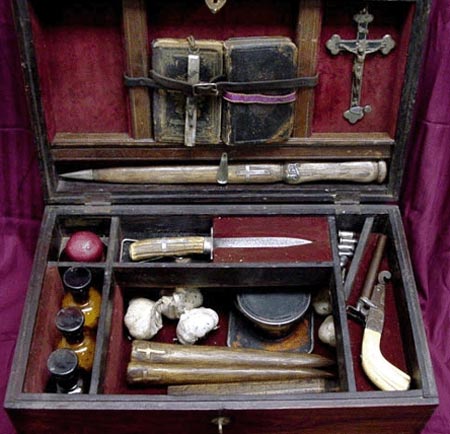
Many vampire kits were made during the 1840s. Bram Stoker's Dracula came out in 1897. So, this kit probably wasn't a novelty item based on a book. Between Dracula having been written 50 years after this kit was made, and the high quality of materials used, I'd guess this was seriously created for killing vampires! Many more vampire killing kits (both old and new) can be found on my new favorite site:
Vampire Killing Kits on Pinterest
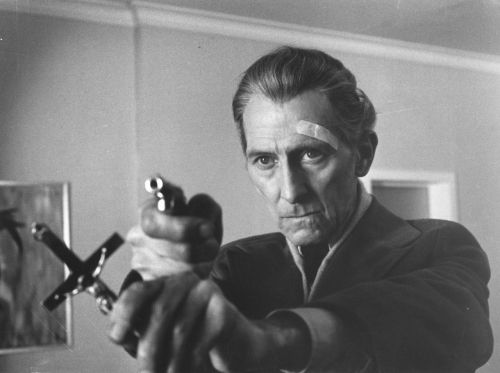
I'd love to see some old photos of the people who carried these kits! I imagine they'd look a little like this:








0 Yorumlar